GHRmodel




Overview
The GHRmodel package supports modeling health outcomes using Bayesian hierarchical spatio-temporal models with complex covariate effects (e.g., linear, non-linear, interactions, distributed lag linear and non-linear models) in the R-INLA framework. It is designed to help users identify key drivers and predictors of disease risk by enabling streamlined model exploration, comparison, and visualization of complex covariate effects.
The image below shows the structure of the GHRmodel package, outlining its functions (in blue), GHRmodel-specific output objects (in purple), generic output objects (in grey), and general functionality. Generic output objects can be provided directly by the user or can be generated using GHRmodel helper functions.

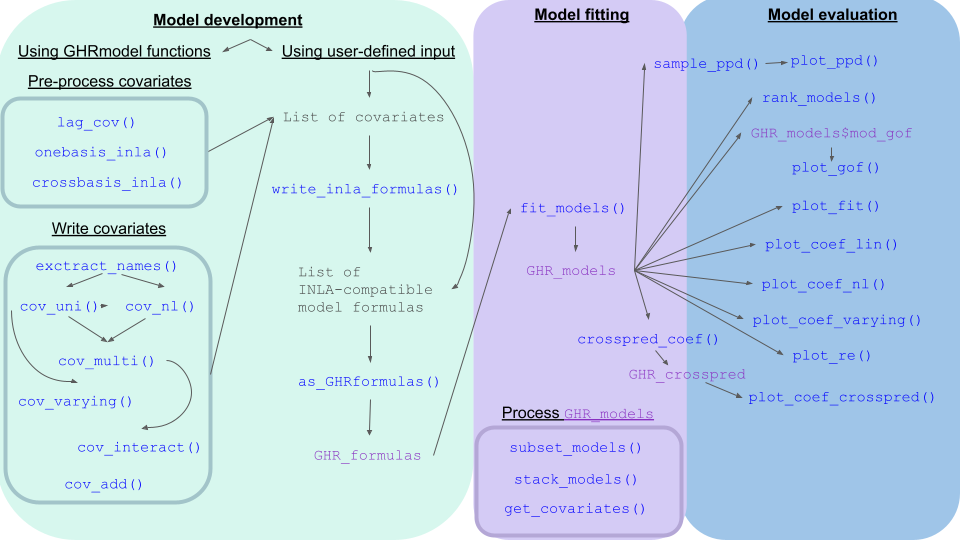
The GHRmodel package is designed to work in tandem with other packages of the GHRtools suite: GHRexplore, which facilitates data exploration and visualization, and GHRpredict, which computes out-of-sample probabilistic predictions of models developed in GHRmodel and enables predictive performance evaluation.
More information about the toolkit, with tutorials and published examples can be found at this website.
Installation
The latest version of the GHRmodel package is hosted on CRAN and can by installed using the following commands:
# Install from CRAN
install.packages("GHRmodel")

# Get the development version from Gitlab
library(devtools)
devtools::install_git('https://earth.bsc.es/gitlab/ghr/ghrmodel.git')
Vignettes
Several vignettes are available to explore GHRmodel. Vignettes loaded in the package can be accessed in R by typing vignette("vignettename") (e.g., vignette("GHRmodel_overview")).
The vignettes are: - "GHRmodel_overview": a general introduction to the main functionalities of the package, including a worked example. - "GHRmodel_covariates": shows how to create INLA-compatible formulas for complex Bayesian spatio-temporal models (including interactions, varying and replicated effects). - "GHRmodel_DLNM": demonstrates how Distributed Lag Nonlinear Models (DLNMs) are integrated into the GHRmodel spatio-temporal Bayesian hierarchical modelling framework to estimate the delayed and nonlinear effects of various exposures on disease risk.
Usage
To fit a model with R-INLA, formulas need to follow its required syntax and structural conventions. INLA-compatible model formulas can be developed using either:
- User-defined INLA-compatible input, which may consist of either user-defined covariate lists or user-defined formula lists.
- GHRmodel helper functions that allow the user to pre-process and transform covariates and streamline writing INLA-compatible formulas.
In this example the user provides a list of INLA-compatible model formulas.
library("GHRmodel")

# Load example dataset
data(dengue_MS)
dengue_MS <- dengue_MS[dengue_MS$year %in% 2010:2012, ]

# Declare formulas
formulas <- c(
  "dengue_cases ~ tmin +  f(year, model='rw1')",
  "dengue_cases ~ pdsi +  f(year, model='rw1')"
)
The fit_models() function allows users to fit a set of INLA-compatible model formulas defined by a GHRformulas object to a provided data set. It automates model fitting, extraction of outputs, and computation of a wide range of goodness-of-fit (GoF) metrics. The output is a GHRmodels object.
# Fit multiple models
results <- fit_models(
  formulas = formulas,
  data = dengue_MS,
  family = "nbinomial",
  offset_var = "pop100000",
  nthreads = 2,
  progress = TRUE
)
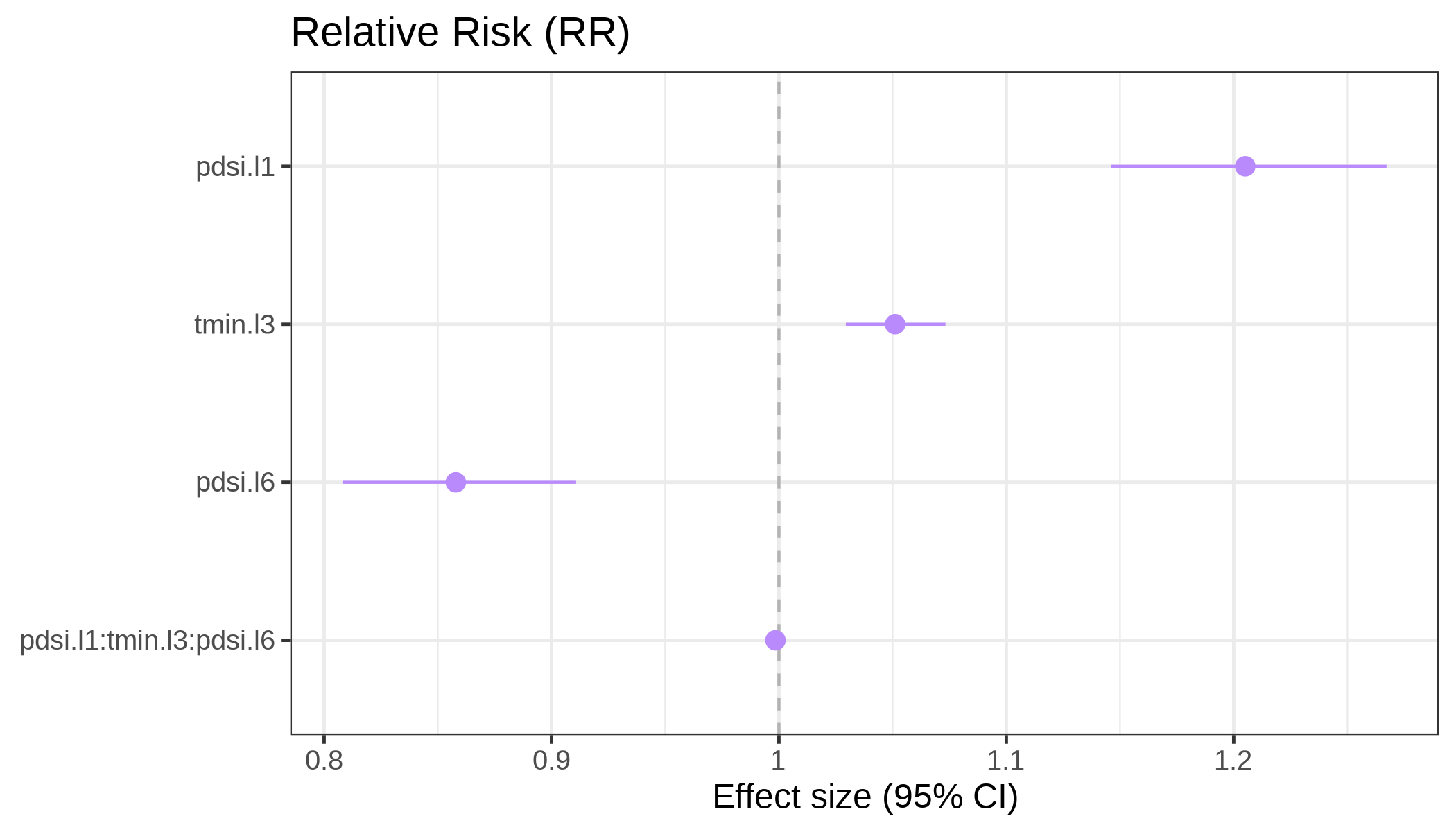
For model evaluation, GHRmodel provides a range of functions for model diagnostics, interpretation and evaluation. Functions with the prefix plot_* return graphical ggplot2 or cowplot objects, allowing users to easily customize visual outputs.
plot_coef_lin(
  model = results,
  exp = TRUE,
  title = "Relative Risk (RR)"
)
Developers
Giovenale Moirano, PhD 
Barcelona Supercomputing Center
Global Health Resilience
Carles Milà, PhD
Barcelona Supercomputing Center
Global Health Resilience
Anna B. Kawiecki, PhD
Barcelona Supercomputing Center
Global Health Resilience
Rachel Lowe, PhD
Barcelona Supercomputing Center
Global Health Resilience (Group leader)